Get Free Audit
Local SEO Services

Local SEO Services for Local Businesses

Roughly 76% of people who search for a local business visit one within a day. Local SEO is how you make sure that business is yours — through Map Pack rankings, optimized Google Business Profile, and city-specific organic visibility.

Get Free Audit
Top 3
Avg Map Pack Position
+180%
Organic Traffic Lift
60-90d
Time to First Results
92%
Client Retention

What's Included

<p class="font-claude-response-body break-words whitespace-normal" dir="ltr" data-sourcepos="7:1-7:46;215-260"><strong>What's Included in Our Local SEO Services</strong></p>
<p class="font-claude-response-body break-words whitespace-normal" dir="ltr" data-sourcepos="12:1-12:421;389-809">Local SEO is the practice of optimizing your online presence so that your business shows up when people search for your products or services in your geographic area. That's the simple definition. The more useful definition is this: Local SEO is the process of proving to Google, through a combination of signals, that your business is relevant, trustworthy, and physically positioned to serve a specific searcher's need.</p>
<p class="font-claude-response-body break-words whitespace-normal" dir="ltr" data-sourcepos="14:1-14:272;811-1082">Google doesn't just want to show searchers "a business that does this thing." It wants to show searchers "the best, most relevant, most trustworthy business that does this thing, near them, right now." Every part of Local SEO exists to answer that question in your favor.</p>
<p class="font-claude-response-body break-words whitespace-normal" dir="ltr" data-sourcepos="16:1-16:252;1084-1335">This is different from traditional (national or organic) SEO in a critical way. National SEO is largely about topical authority and backlinks &mdash; it doesn't care where you're physically located. Local SEO layers geography on top of that. It cares about:</p>
<ul class="[li_&amp;]:mb-0 [li_&amp;]:mt-1 [li_&amp;]:gap-1 [&amp;:not(:last-child)_ul]:pb-1 [&amp;:not(:last-child)_ol]:pb-1 list-disc flex flex-col gap-1 pl-8 mb-3 print:block print:space-y-1" dir="ltr" data-sourcepos="18:1-22:73;1337-1708">
<li class="font-claude-response-body whitespace-normal break-words pl-2" data-sourcepos="18:1-18:71;1337-1407">Where your business is physically located (or the areas you service)</li>
<li class="font-claude-response-body whitespace-normal break-words pl-2" data-sourcepos="19:1-19:80;1408-1487">Whether your business information is consistent and verifiable across the web</li>
<li class="font-claude-response-body whitespace-normal break-words pl-2" data-sourcepos="20:1-20:72;1488-1559">Whether people who've used your business vouch for it through reviews</li>
<li class="font-claude-response-body whitespace-normal break-words pl-2" data-sourcepos="21:1-21:76;1560-1635">Whether your website and content specifically address local search intent</li>
<li class="font-claude-response-body whitespace-normal break-words pl-2" data-sourcepos="22:1-22:73;1636-1708">Whether your Google Business Profile is active, accurate, and engaging</li>
</ul>
<p class="font-claude-response-body break-words whitespace-normal" dir="ltr" data-sourcepos="24:1-24:265;1710-1974">Get these signals right, and you start showing up in two of the most valuable pieces of real estate in local search: the <strong>Map Pack</strong> (the three business listings shown with a map at the top of local search results) and the <strong>organic local results</strong> just below it.</p>

Request a Quote
What's Included

Our Approach

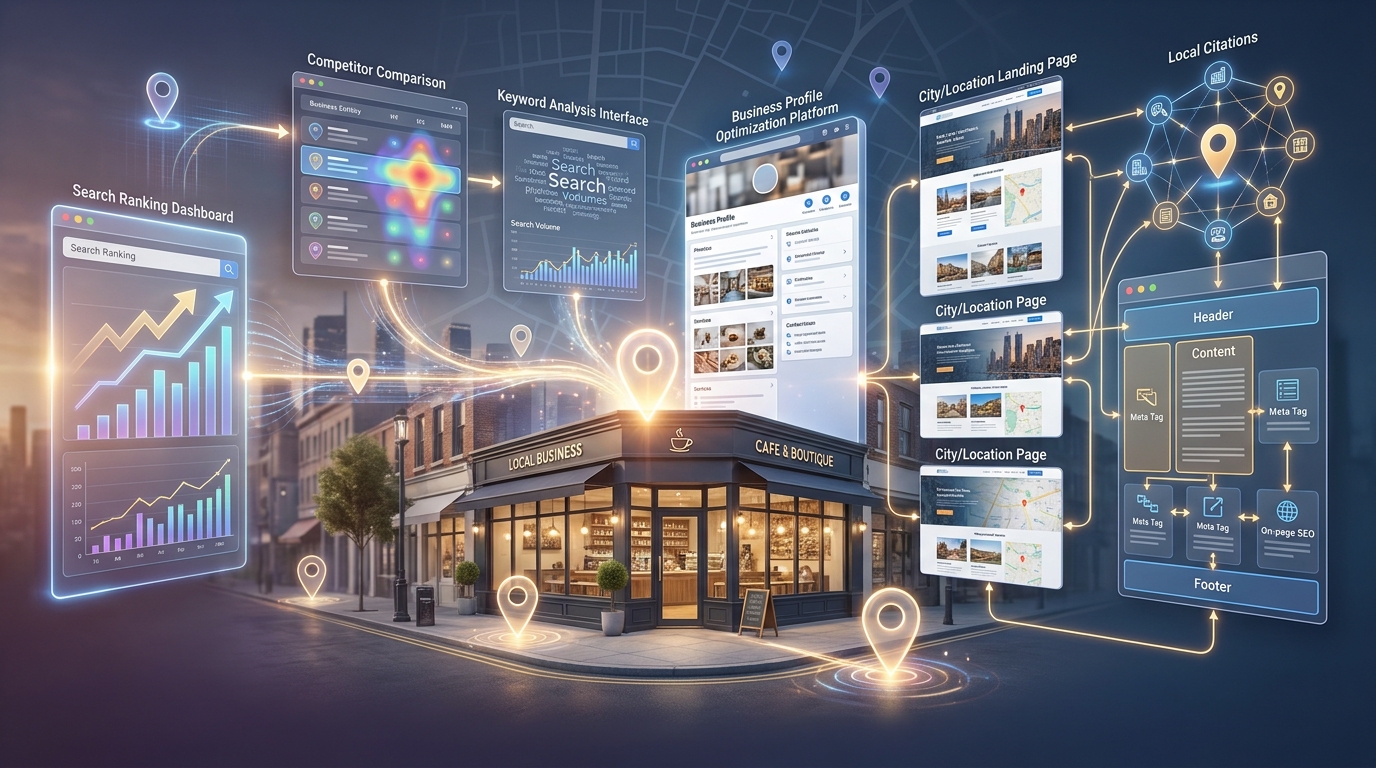
<p class="font-claude-response-body break-words whitespace-normal" dir="ltr" data-sourcepos="34:1-34:215;2094-2308">Local SEO isn't one tactic. It's a system made up of several interlocking components, and businesses that only address one or two of them tend to hit a ceiling. Here's a breakdown of each pillar and why it matters.</p>
<h3 class="mt-2 -mb-1 text-base font-bold" dir="ltr" data-sourcepos="36:1-36:50;2310-2359">1. Google Business Profile (GBP) Optimization</h3>
<p class="font-claude-response-body break-words whitespace-normal" dir="ltr" data-sourcepos="37:1-37:686;2360-3045"><a href="../services/gmb">Google Business Profile optimization</a> is arguably the single most important asset in Local SEO. It's the listing that shows up in the Map Pack, in Google Maps, and alongside your organic results in a "knowledge panel" when someone searches your business name directly. A properly optimized GBP includes accurate business information, the right primary and secondary categories, correct service area settings, strong photo activity, regular posts, active Q&amp;A management, and prompt review responses. A neglected GBP is one of the most common reasons a genuinely good business fails to rank, even when everything else about the business is strong.</p>
<h3 class="mt-2 -mb-1 text-base font-bold" dir="ltr" data-sourcepos="39:1-39:45;3047-3091">2. Citation Building and NAP Consistency</h3>
<p class="font-claude-response-body break-words whitespace-normal" dir="ltr" data-sourcepos="40:1-40:566;3092-3657">A "citation" is any online mention of your business's Name, Address, and Phone number (NAP) &mdash; on directories like Yelp, Bing Places, Apple Maps, and dozens of industry-specific directories. Google uses the consistency of this information across the web as a trust signal. Even small formatting inconsistencies can create doubt in Google's algorithm and quietly suppress your Map Pack eligibility. This is unglamorous work, but it's foundational &mdash; no amount of content or reviews will fully overcome a business whose basic information is inconsistent across the web.</p>
<h3 class="mt-2 -mb-1 text-base font-bold" dir="ltr" data-sourcepos="42:1-42:27;3659-3685">3. Local Landing Pages</h3>
<p class="font-claude-response-body break-words whitespace-normal" dir="ltr" data-sourcepos="43:1-43:589;3686-4274">If your business serves multiple cities or neighborhoods, a single generic "Services" page trying to rank for every location at once is almost never enough. Google increasingly rewards specificity &mdash; a dedicated page built for a specific service in a specific neighborhood will consistently outperform a broad citywide page trying to cover the same ground. The mistake most businesses make is creating thin, templated pages that just swap out the city name; Google's algorithms are very good at detecting this, and thin duplicate content can do more harm than having no local pages at all.</p>
<h3 class="mt-2 -mb-1 text-base font-bold" dir="ltr" data-sourcepos="45:1-45:25;4276-4300">4. On-Page Local SEO</h3>
<p class="font-claude-response-body break-words whitespace-normal" dir="ltr" data-sourcepos="46:1-46:450;4301-4750">This covers the technical and structural elements of your website that help Google understand your local relevance: schema markup (specifically LocalBusiness schema), title tags and meta descriptions with location and service keywords, internal linking structure between service and location pages, NAP information embedded on the site itself, and mobile responsiveness and page speed &mdash; since the majority of local searches happen on mobile devices.</p>
<h3 class="mt-2 -mb-1 text-base font-bold" dir="ltr" data-sourcepos="48:1-48:40;4752-4791">5. Review Generation and Management</h3>
<p class="font-claude-response-body break-words whitespace-normal" dir="ltr" data-sourcepos="49:1-49:568;4792-5359">Reviews are one of the strongest trust signals in local search &mdash; both to Google's algorithm and to the human being deciding whether to call you or your competitor. A business with 150 reviews at 4.8 stars will almost always outperform a competitor with 12 reviews at 4.9 stars, purely on volume and recency signals. A real review strategy includes a consistent, systematic process for asking for reviews, making it easy for customers to leave one, responding to every review thoughtfully, and having a plan for negative reviews that addresses concerns professionally.</p>
<h3 class="mt-2 -mb-1 text-base font-bold" dir="ltr" data-sourcepos="51:1-51:31;5361-5391">6. Reporting and Iteration</h3>
<p class="font-claude-response-body break-words whitespace-normal" dir="ltr" data-sourcepos="52:1-52:459;5392-5850">Local SEO isn't a "set it and forget it" project. Rankings shift, competitors adjust, and Google's algorithm evolves. A proper Local SEO program includes ongoing tracking of Map Pack and organic rankings, GBP performance, organic traffic and conversion trends, citation health, and review volume and sentiment over time. Without this feedback loop, it's impossible to know what's actually working &mdash; or to catch a problem before it costs significant business.<br><br><img src="../assets/uploads/case-studies/d634076984924ef6542c923a461a12b7.jpg" alt="" style="max-width:100%;height:auto;border-radius:10px;"></p>

Request a Quote
Our Approach

Everything You Need to Rank Locally

Google Business Profile Optimization
Full GBP setup and optimization — categories, service areas, posts, and Q&A — built to convert profile views into calls.
Local Landing Pages
City and neighborhood-specific pages targeting exactly how your customers search in your service area.
Citation Building & Cleanup
Consistent NAP data across 80+ directories — fixing the inconsistencies that quietly suppress Map Pack eligibility.
On-Page Local SEO
Schema markup, internal linking, and content structure that signals local relevance to Google.
Review Generation & Management
A system for consistently earning and responding to reviews — the trust signal customers check first.
Monthly Reporting Dashboard
Live tracking of rankings, GBP performance, and traffic — updated weekly, not a monthly PDF.

Common Questions About Local SEO

How long does Local SEO take to work?

Most clients see Map Pack movement within 60-90 days. Highly competitive markets can take 4-6 months for full dominance.

Do I need a website for Local SEO to work?

A website helps significantly, but Google Business Profile optimization alone can produce real Map Pack improvement even with a basic site.

What's the difference between Local SEO and regular SEO?

Local SEO specifically targets geographically-bound searches and the Map Pack, using signals like GBP, citations, and proximity that don't apply to national SEO.

How is this different from paid ads?

Local SEO compounds over time and keeps working after you stop actively investing in new content. Paid ads stop the moment you stop paying.

Ready to Get Started with Local SEO Services?

Get Free Audit