Core Web Vitals, schema markup, crawl architecture, and site speed optimization — the foundation every other SEO effort depends on.
<p class="font-claude-response-body break-words whitespace-normal" dir="ltr">Slow load times, broken internal links, duplicate content, and crawl errors quietly cap how well even your best content can rank. Technical SEO is invisible to visitors but decisive to Google — and it's usually the first thing we fix before anything else.</p>
<p class="font-claude-response-body break-words whitespace-normal" dir="ltr">A site can have perfectly written service pages, strong local content, and genuine expertise behind every word — and still sit on page two because Google is struggling to crawl it efficiently, load it quickly, or make sense of its structure. These issues don't show up as obvious red flags to a visitor scrolling through the site; they show up as a slow, steady ceiling on rankings that never quite lifts no matter how much new content gets published on top of it.</p>
<p class="font-claude-response-body break-words whitespace-normal" dir="ltr">That's what makes technical SEO different from every other part of a growth strategy. It's not something a customer notices and compliments — it's something that, when broken, silently limits everything else you're investing in. Fixing it doesn't create rankings out of nothing; it removes the invisible cap that was holding back content and local SEO work that was already good enough to perform, if only Google could crawl, render, and trust the site properly in the first place.</p>

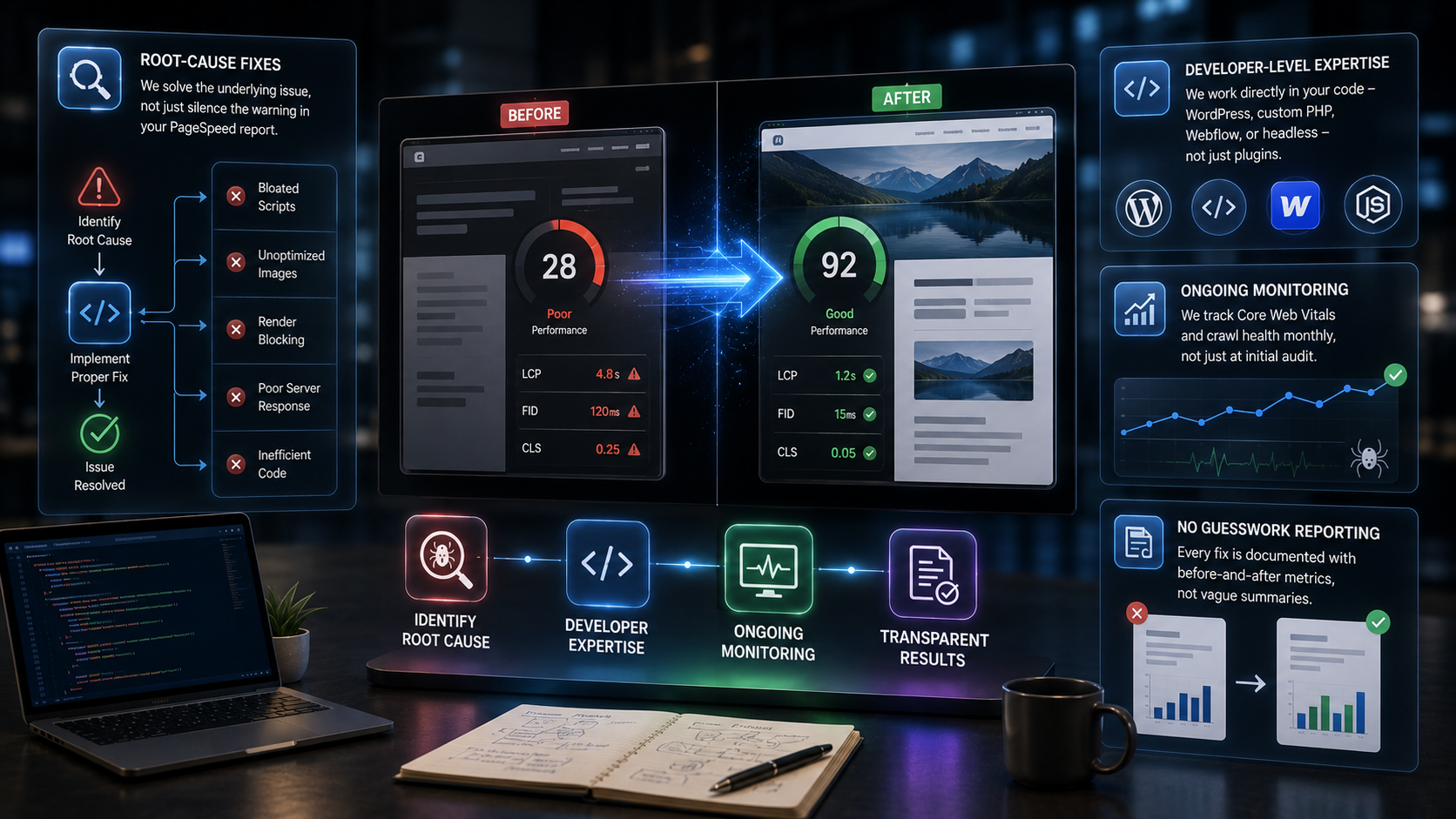
<p class="font-claude-response-body break-words whitespace-normal" dir="ltr">Instead of chasing individual PageSpeed warnings, we look for the underlying causes — bloated scripts, unoptimized images, poor server response times — and fix them once, properly, so the improvement holds over time.</p>
<p class="font-claude-response-body break-words whitespace-normal" dir="ltr">Most technical SEO "fixes" on the market treat symptoms one at a time: compress this image, defer that script, add a caching plugin, move on to the next warning in the report. That approach can nudge a score up temporarily, but it rarely holds — six months later, new plugins, new content, and new images get added on top of the same underlying weak points, and the warnings quietly come back.</p>
<p class="font-claude-response-body break-words whitespace-normal" dir="ltr">Our approach starts by tracing every flagged issue back to its actual cause before touching anything. A slow load time might be flagged as five separate warnings in a PageSpeed report, but often traces back to one or two real bottlenecks — an oversized JavaScript bundle loading before it's needed, or a server response time that's slow regardless of what's on the page. Fixing that root cause resolves multiple symptoms at once, and because the actual cause is gone rather than masked, the improvement holds as the site continues to grow instead of quietly eroding again within a few months.</p>

Everything we audit and fix to give your site a rock-solid technical foundation.

One-time audit and fix, or ongoing monthly monitoring — your choice.
Technical SEO covers everything that affects how well Google can crawl, render, and index your site — speed, mobile usability, schema, and crawl structure.
Yes — we work across WordPress, custom PHP, Webflow, Shopify, and headless frameworks like Next.js and Astro.
A full audit typically takes 5–7 business days depending on site size, with a walkthrough call once complete.
Both are available — the Audit plan gives you a prioritized report, while Fix & Monitor includes hands-on implementation.
It removes a ceiling on your rankings, but it works best paired with strong content and local SEO — we're happy to bundle services.
Free audit — see exactly what's slowing your site down and holding back your rankings.
Get Free Audit